

In the digital age of banking and financial services, automation plays a critical role in making transactions seamless and efficient. One of the key systems that facilitate recurring payments in India is the Electronic Clearing Service (ECS) mandate. Despite the introduction of newer technologies like NACH (National Automated Clearing House), ECS remains an essential part of the payment landscape for many.
In this blog, we’ll explore the ECS mandate, its meaning, charges, uses, and how it differs from NACH. We will also delve into common FAQs surrounding ECS mandates to provide a clear understanding of this financial tool.
What ECS Mandate?
The ECS mandate, short for Electronic Clearing Service mandate, is an authorisation provided by an individual or an entity to a bank, allowing the automatic deduction of payments from their account. The ECS system facilitates bulk transfers from one bank account to multiple accounts, commonly used for recurring transactions such as loan repayments, utility bills, insurance premiums, and SIP investments.
ECS Mandate Meaning
Simply put, the ECS mandate meaning refers to a pre-authorisation granted by the account holder to their bank, enabling them to transfer funds on behalf of the account holder on a regular basis. These transactions happen without the need for manual intervention, ensuring that payments are made on time and consistently.
Types of ECS Mandates
There are two main types of ECS mandates:
- ECS Debit Mandate: This is used when funds need to be debited (or withdrawn) from an individual’s account for recurring payments like loan EMIs or utility bills.
- ECS Credit Mandate: This is used for crediting an individual’s account, commonly employed for salary payments, dividends, or pension transfers.
What is ECS Mandate Charges?
One common question is: what are ECS mandate charges? Typically, ECS mandate charges refer to the fees levied by banks or service providers for setting up and processing ECS transactions. These charges can vary between banks, but they are generally minimal or, in many cases, non-existent for most users.
Some service providers may charge a nominal fee for ECS mandate setups, especially for commercial use. However, individuals using ECS for personal purposes (such as bill payments) may not encounter any substantial fees.
How does ECS Mandate Work?
The process of setting up an ECS mandate is relatively simple:
- The account holder submits a mandate form to their bank or the institution collecting the payment (such as a utility company or loan provider).
- This mandate provides the authority to debit the specified account for recurring payments.
- The bank then processes the ECS mandate and enables automatic deductions from the account based on the mandate terms.
- Once the ECS mandate is in place, the system takes care of the transactions automatically on the agreed-upon dates, ensuring timely payments.
How to Cancel ECS Mandate?
For various reasons, individuals may want to cancel their ECS mandate. The steps for how to cancel the ECS mandate are straightforward:
- Visit your bank branch and submit a written application to cancel the ECS mandate. Alternatively, some banks offer online facilities to cancel ECS mandates.
- Provide the necessary details like account number, mandate reference number, and the reason for cancellation.
- The bank will then process your request and stop further automatic deductions.
- It’s important to cancel the mandate well in advance to avoid any unintended payments in the next cycle.

Difference Between ECS and NACH
While both ECS and NACH facilitate recurring payments, there are key differences between the two systems:
| Feature | ECS Mandate | NACH Mandate |
| Processing Time | Slower; manual intervention often required. | Faster; fully automated and electronic. |
| Geographical Coverage | Limited to specific banks and regions. | Nationwide coverage, including most banks. |
| Mandate Verification | Takes longer due to physical processing. | Real-time verification of mandates. |
| Cost Efficiency | Can involve higher processing costs for banks. | Lower operational costs due to automation. |
| Security | Lesser security features compared to NACH. | Higher security with encryption and validation. |
Advantages of ECS Mandate
- Convenience: Once set up, ECS mandates allow automatic payments, reducing the need for manual transactions every month.
- Timely Payments: ECS ensures that payments such as EMIs or bills are paid on time, avoiding late fees.
- No Manual Monitoring: Since payments are automated, there’s no need to track due dates.
- Useful for Multiple Payments: ECS is ideal for institutions making bulk payments, such as salary disbursements, dividend distributions, etc.
Disadvantages of ECS Mandate
- Manual Setup: ECS mandates often require physical submission of forms and signatures, making the process slower than newer technologies like NACH.
- Delayed Transactions: ECS transactions can take longer to process, sometimes leading to delays in payment.
- Difficult to Modify: Cancelling or modifying an ECS mandate is more complex than with NACH.
- Limited Coverage: ECS is only available with certain banks and regions, unlike NACH, which is available across the country.
Common Uses
- Loan EMIs: Banks and financial institutions often use ECS mandates to collect monthly EMIs from borrowers.
- Utility Bills: Services like electricity, water, and internet bills can be paid automatically using ECS.
- Mutual Fund SIPs: Systematic Investment Plans (SIPs) are often set up via ECS mandates for regular investments.
- Salary Payments: Many organisations use ECS mandates to pay employee salaries or other recurring credits.
Regulatory Updates Affecting ECS
ECS mandates, while a cornerstone of India’s payment landscape, are subject to evolving regulatory frameworks. Here are some key regulatory updates that have impacted or may potentially impact ECS mandates:
Reserve Bank of India (RBI) Guidelines
Unified Payments Interface (UPI): The RBI has actively promoted UPI as a real-time payment system. While UPI has not directly replaced ECS for recurring payments, its growing popularity has led to some shifts in payment preferences.
Digital Payments: The RBI has implemented various initiatives to promote digital payments, which might indirectly impact the use of ECS mandates. For instance, if customers increasingly opt for digital wallets or card payments for recurring bills, the need for ECS mandates could decrease.
Payment and Settlement Systems Act, 2007
The government has periodically amended the Payment and Settlement Systems Act to keep pace with technological advancements and regulatory changes. These amendments have implications for ECS mandates, especially in terms of security, efficiency, and interoperability.
National Payments Corporation of India (NPCI)
NPCI, the umbrella organisation for retail payments in India, has been continuously enhancing the National Automated Clearing House (NACH) system. These enhancements might lead to greater adoption of NACH over ECS for certain types of recurring payments.
Data Privacy and Security Regulations
The government’s proposed Personal Data Protection Bill, once enacted, will have significant implications for data handling and security. ECS mandates, as they involve the processing of personal and financial data, will need to comply with these regulations.
GST Regulations
The Goods and Services Tax (GST) regime has introduced ECS as a method for making GST payments. While this has increased the usage of ECS for business-to-government transactions, it has also brought specific regulatory requirements related to GST compliance.
It’s crucial for individuals and businesses using ECS mandates to stay updated with these regulatory changes. Non-compliance can lead to penalties and other legal consequences. Regularly checking the RBI’s website and NPCI’s announcements and consulting with legal or financial experts can help ensure adherence to the latest regulatory requirements.
Importance of Modern Payment Gateways for Automating Recurring Transactions
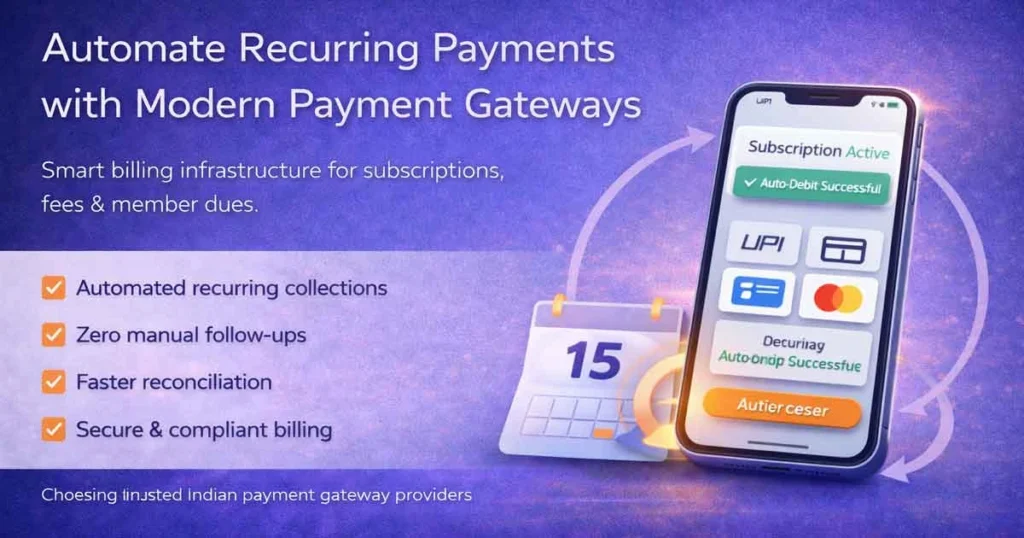
Recurring payments need a sound digital infrastructure to be automated. An effective payment gateway in India assists companies in collecting charges in a periodic form without handling them manually.
- Online Payment Gateways in India streamline subscription, fee and member dues recurring billing.
- The Payment Gateway Companies in India which is trusted by businesses to provide secure and compliant automatic collections.
- The selection of Indian Payment Gateway Providers can help to significantly minimize delays and errors in reconciliation.
Contemporary payment systems minimize the use of paper-based requirements such as ECS, which creates speed and transparency.
Why Businesses Moving from ECS Prefer Payment Aggregators
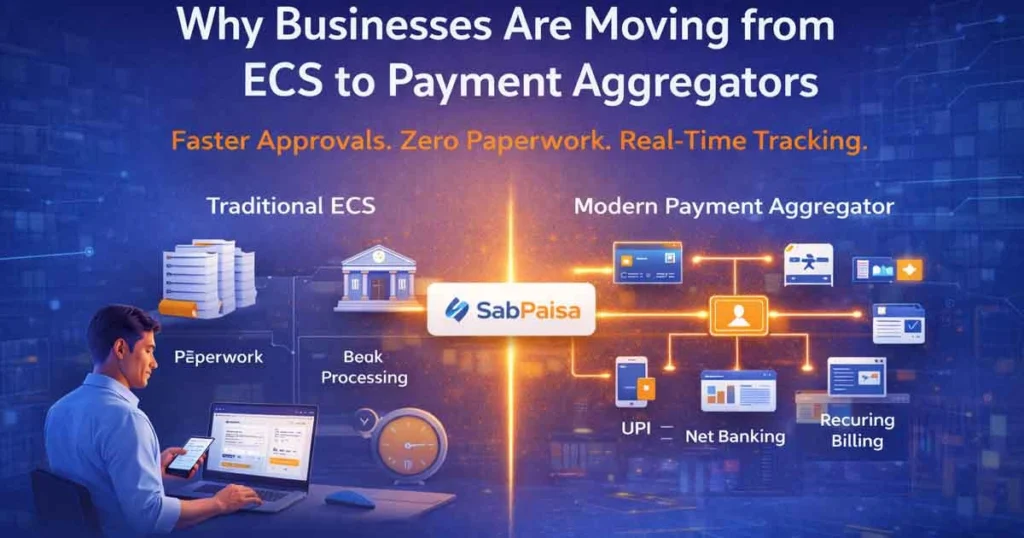
The mandates of traditional ECS are paperwork, visits to the branch, and slow processing. Most companies are turning to digital options.
- A Payment Aggregator is a centralised system that combines various payment systems and simplifies the configuration.
- Payment Aggregators in India allow fast recurring approvals without paperwork.
- Organizations are turning to top payment aggregators in India to do quicker onboarding, compliance, and real-time tracking.
With the help of aggregators such as SabPaisa, the companies can speed up collection and decrease overhead expenses.
One-Stop Payment Solutions for Recurring Debit Mandates
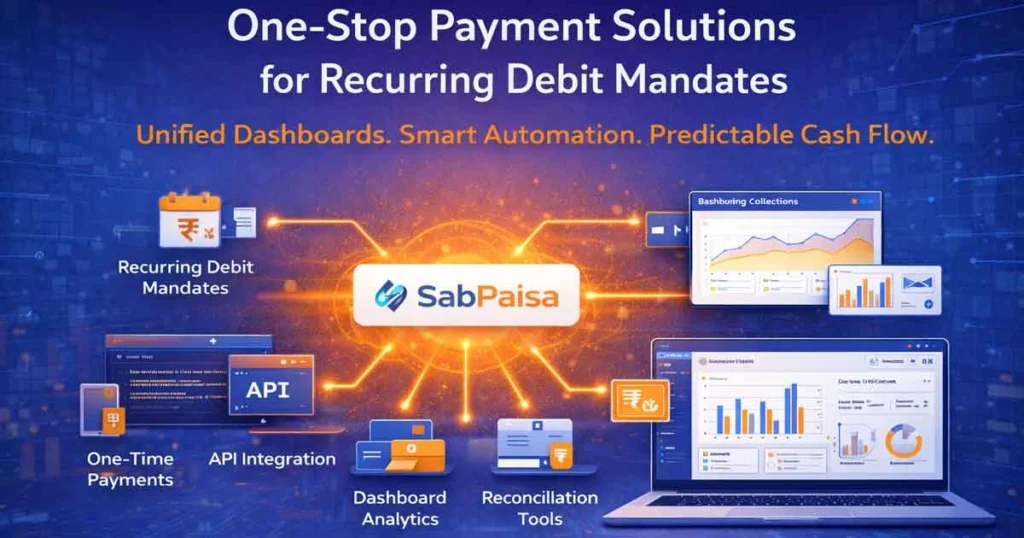
The advantages of recurring payment processes are that they are consolidated and can be configured and executed with very little friction.
- One stop payment services assist in one time and recurrent collections.
- One Stop Payment Solutions are the integration of dashboards, APIs, reconciliation tools and reporting.
- Modern Payment Solutions minimize human intervention and enhance the predictability of cash flows.
With integrated platforms like SabPaisa’s suite, businesses gain a unified view of recurring debit mandates and related analytics.
Choosing the Best Gateway for Recurring Collection Needs
Choosing the appropriate gateway will provide reliability and scalability in repeated debits and subscriptions.
- Compare the best payment gateway in India according to uptime, integration, and support.
- Best payment gateway websites in India provide detailed APIs and webhooks.
- An Ideal payment gateway site must state pricing, settlement schedules, and conformance.
- A robust Payment Gateway Company In India collaborates with companies in order to develop and comply with regulations.
- Recurring mandates are supported with highly advanced automation at trusted Payment Gateway Provider India platforms such as SabPaisa.
This assists businesses to minimise the number of mistakes made by hand and computerizes repeat collections.
Payment Gateway Integrations for Subscription-Based Platforms
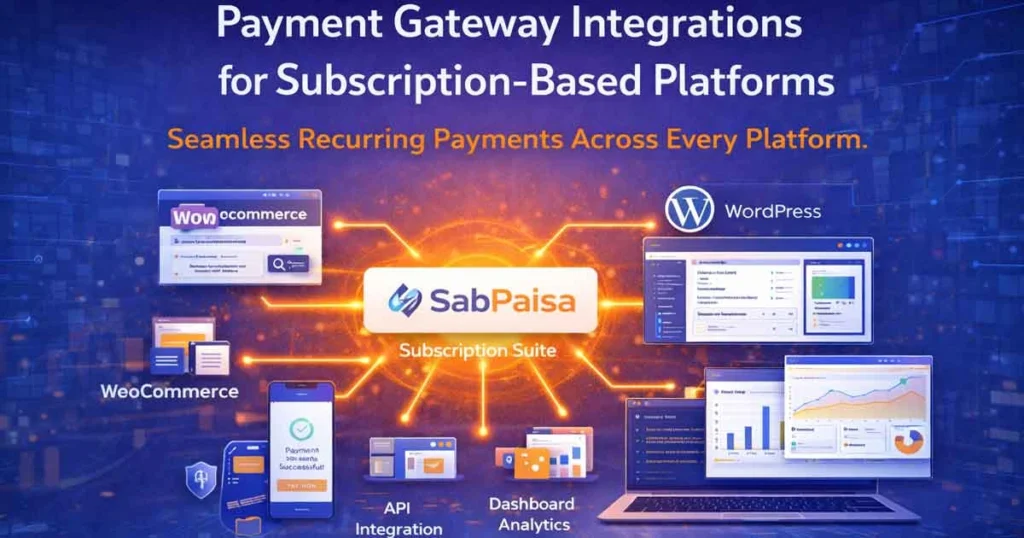
Recurring setups work best when the payment gateway integrates smoothly with the business platform.
- Ecommerce payment gateway options enable seamless checkout for subscription purchases.
- Woocommerce payment gateway support allows stores on WooCommerce to automate recurring payments.
- WordPress payment gateway integrations power subscription portals and member sites.
- Wix payment gateway allows the acceptance of recurring plans on sites built on Wix.
These integration options give the assurance that recurrent transactions are done securely regardless of the platform.
Instant Payouts & Payout APIs for Businesses Handling ECS Reversals or Refunds
Traditional settlement systems in the changing digital payments environment frequently lead to delays that can damage cash flow, particularly when responding to ECS reversals or customer refunds. Instant payout system enables a business to send an immediate payment directly to the receipt and removes the lengthy queues and improves the overall effectiveness of the finances. Instant payout service rails are provided over regulated platforms, such as UPI and IMPS, which allow real-time settlements, eliminating reliance on batch processes or bank working hours. Companies can now automate such disbursements using a dedicated payout API, and these disbursements can be now made directly out of their systems, with reduced manual intervention and enhanced accuracy on the reconciliation side. Such an arrangement does not only speed up the processing of refunds and reversal but also builds trust among partners, sellers, and end-customers.
Key benefits include:
- Quick access to funds: Beneficiaries are able to access funds in real time or within a few minutes and eliminate delays in settlement.
- Automated workflow: A payout API is an interface that automates the workflow transfer of funds to beneficiaries without manual clicks or reliance on a bank portal.
- Better liquidity: Businesses will be able to handle refunds and ECS reversals much faster, which benefits the health of cash flow.
- Improved control and monitoring: APIs in real time provide visibility into payout status and success rates, which can be used in reconciliation and reporting.
- 24 hours to access funds: Money can be released at any hour, even when the bank is not operational, and this has enhanced customer satisfaction.
Platforms such as SabPaisa combine these features of instant payouts with powerful payout APIs to assist businesses to handle refunds and reversals with reliability without compromising regulatory or operational efficiency.
Payment Links as a Modern Alternative to ECS Setup for Small Businesses
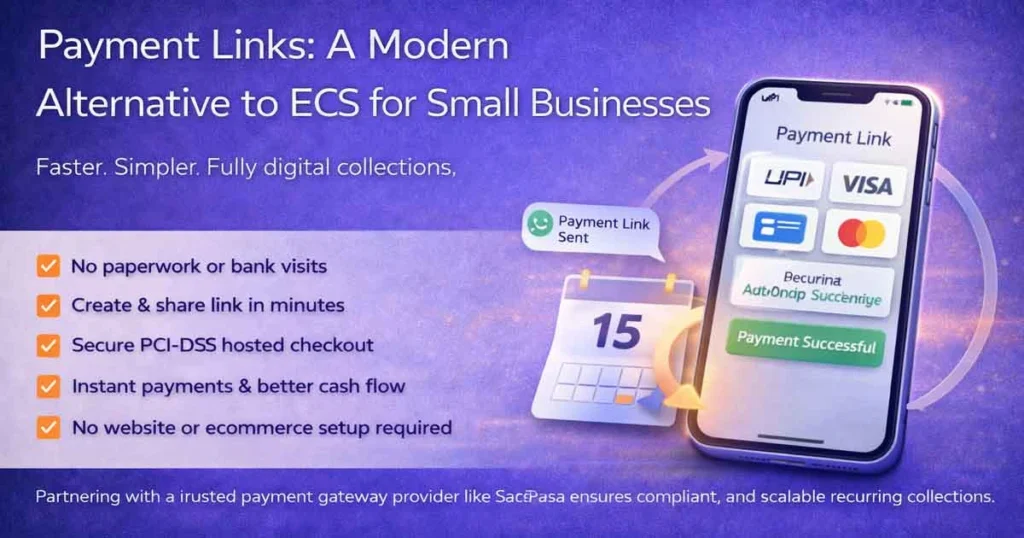
Traditional ECS mandates are paperwork, bank visits, and long set up times, and are not as practical as regular collection in many small businesses. Payment links, on the contrary, are a more contemporary and versatile alternative to fast, digital payment capture with no heavy infrastructure. A payment link generator enables every company to generate a payment link within minutes, send it via SMS, WhatsApp, email, or social apps, and allow customers to pay right away with a secure checkout page. This can be of particular benefit to businesses that lack a website or even a complete ecommerce platform since payment links can remove obstacles that hinder online collections and enhance convenience and cash flow.
The reason payment links are best suited to small businesses:
- Easy installation: There is no requirement to install a complete ECS form, bank approval or technical integration, just create a link and send it.
- Easy sharing: The links can be shared through WhatsApp, SMS, or email, reaching customers wherever they are.
- Authorized and compliant: Hosted links direct customers to PCI-DSS-secured checkouts, ensuring transactions are secure.
- Enhanced cash flow: Payments are received immediately and delays caused by antiquated debit systems are minimized.
- No website required: Small retailers do not need to construct an online store or a checkout page to collect payment.
Conclusion
The ECS is a valuable tool for automating recurring payments, helping both individuals and businesses manage their finances efficiently. While newer systems like NACH offer faster processing and better security, ECS remains a widely used system in India, particularly for older institutions or customers who prefer traditional banking methods.
Whether you are looking to automate your monthly utility payments or need a reliable way to ensure timely EMI payments, ECS is a helpful option. However, with NACH providing enhanced capabilities, it’s worth considering upgrading to this modern system for a more seamless experience.
FAQs
1. What is ECS mandate?
An ECS mandate is a pre-authorisation provided by an account holder to allow automatic deductions from their bank account for recurring payments like EMIs, bills, or investments.
2. What are ECS mandate charges?
ECS mandate charges refer to the fees levied by banks for processing ECS transactions. These charges are usually nominal or waived off for personal use but may vary depending on the bank.
3. How to cancel ECS mandate?
To cancel an ECS mandate, you can visit your bank branch and submit a written request. Alternatively, some banks provide online options to stop the mandate.
4. ECS mandate vs NACH: What’s the difference?
NACH is faster, more secure, and fully automated compared to ECS, which involves slower manual processing and limited geographical coverage.
5. Can I modify an ECS?
Modifying an ECS mandate can be cumbersome, often requiring the submission of a new mandate form. It’s easier to manage changes in systems like NACH.
6. Is ECS still relevant with the advent of NACH?
Yes, ECS is still in use, although NACH is quickly becoming the preferred system due to its superior technology and faster processing capabilities.