
Table of Contents
In 2026, waiting for money is no longer an option. For Indian businesses, “instant payout” has moved from being a luxury to a basic necessity. Whether it’s a marketplace paying its sellers, an insurance company settling a claim, or a startup disbursing a loan, success now depends on how quickly and safely money moves.
The Shift to a “Compliance-First” India. While standard T+1 or T+2 settlement cycles are still common across many traditional channels, market preferences are shifting. Today’s businesses and consumers increasingly expect the speed and liquidity that only instant, 24/7 payout rails can provide. But speed is no longer the only priority. Businesses are now required to adopt a compliance-first strategy in line with evolving RBI regulatory expectations. This implies that all immediate transfers should be transparent, traceable, and processed by licensed participants that adhere to stringent regulations governing the storage and transfer of funds.
The adoption of enterprise-grade payout APIs is now the norm, as businesses prioritize systems that are fully compliant with national financial regulations. These interfaces enable companies to transfer money instantly via UPI, IMPS, and 24/7 bank rails, and automatically handle the legal paperwork that is too complex to be completed manually by the RBI and NPCI.
This blog serves as a complete 101 guide to instant payout for businesses in 2026 covering definitions, benefits, working models, use cases, and how a regulated payout service provider in India, like SabPaisa, fits into this ecosystem, in line with RBI and NPCI frameworks.
What Is Instant Payout?
An instant payout is a digital payment solution that allows businesses to transfer funds to a recipient’s bank account or wallet immediately upon a specific trigger event. Rather than navigating traditional, time-consuming accounts payable cycles or waiting days for batch processing, businesses can make hassle-free disbursements to a wide range of stakeholders through their preferred payment methods.
While frequently associated with paying employees, contractors, and gig workers, the utility of instant payouts extends across the entire business ecosystem, including:
- Marketplace Sellers & Partners: Immediate settlement of sales proceeds or commissions.
- Vendors: On-demand payments for goods and services to improve supply chain relationships.
- Customer Refunds: Instant reversals for e-commerce returns to enhance consumer trust.
- Claims & Disbursements: Rapid processing of insurance claims, loan dispatches, or government incentives.
In India, instant payouts are facilitated via regulated payment rails, most notably UPI (Unified Payments Interface) and IMPS (Immediate Payment Service). To ensure full compliance with RBI and NPCI frameworks, businesses typically access these rails through a licensed payout gateway or API provider.
However, it is important for businesses to manage expectations regarding transaction boundaries. While these rails are designed for speed, they are governed by indicative limits—typically around ₹1 lakh for UPI and ₹5 lakh for IMPS. It is crucial to note that these limits are not fixed; they can vary based on specific bank-level configurations, the nature of the use case, and evolving regulatory guidelines. Additionally, users should account for potential bank-side downtime or network latency, which may occasionally result in near-real-time rather than instantaneous delivery.
Why Instant Payout Matters for Indian Businesses in 2026
Three structural shifts drive the demand for instant payouts:
- Platform-based business models: Marketplaces, aggregators, and gig platforms need to settle their users quickly in order to maintain them.
- Transparency emphasis: RBI requires transparency audit trails, beneficiary checks and limited fund movements.
- Differentiation in customer experience: Delays in refunds or payouts discredit the service and reduce repeat business.
- Improved Risk Management: RBI and NPCI guidelines emphasize the importance of real-time monitoring, robust fraud controls, and AML (Anti-Money Laundering) safeguards for high-speed payout systems. Because instant transfers are irreversible, these frameworks focus on proactive detection to prevent financial loss and ensure the integrity of the payment ecosystem.
Therefore, instant payouts are no longer the privilege of fintechs but are a necessity to enterprises, NBFCs, co-operative banks, and other regulated organisations.
Key Benefits of Using an Instant Payout Payment Gateway
Implementing an instant payout solution offers multiple business advantages:
- Reduced settlement times: Money is received by the recipients instantly, leading to better liquidity and satisfaction.
- Cost efficiency: Instant payouts decrease manual intervention and overheads in terms of reconciliation.
- Better trust towards partners: Sellers, agents and vendors prefer platforms where they receive predictable and instant payouts.
- Extensible disbursement services: APIs enable companies to make high-volume payments without overloading the system.
- Higher transaction success rates: Some advanced payout APIs utilize smart routing to choose the most reliable payment rail (such as UPI vs. IMPS) in real-time. Where supported, this technology helps bypass localized bank downtime and ensures higher completion rates for critical payments.
- Regulatory alignment: A trusted payout service company makes sure that it complies with regulations of RBI and NPCI guidelines.
How Instant Payout Works: Step-by-Step
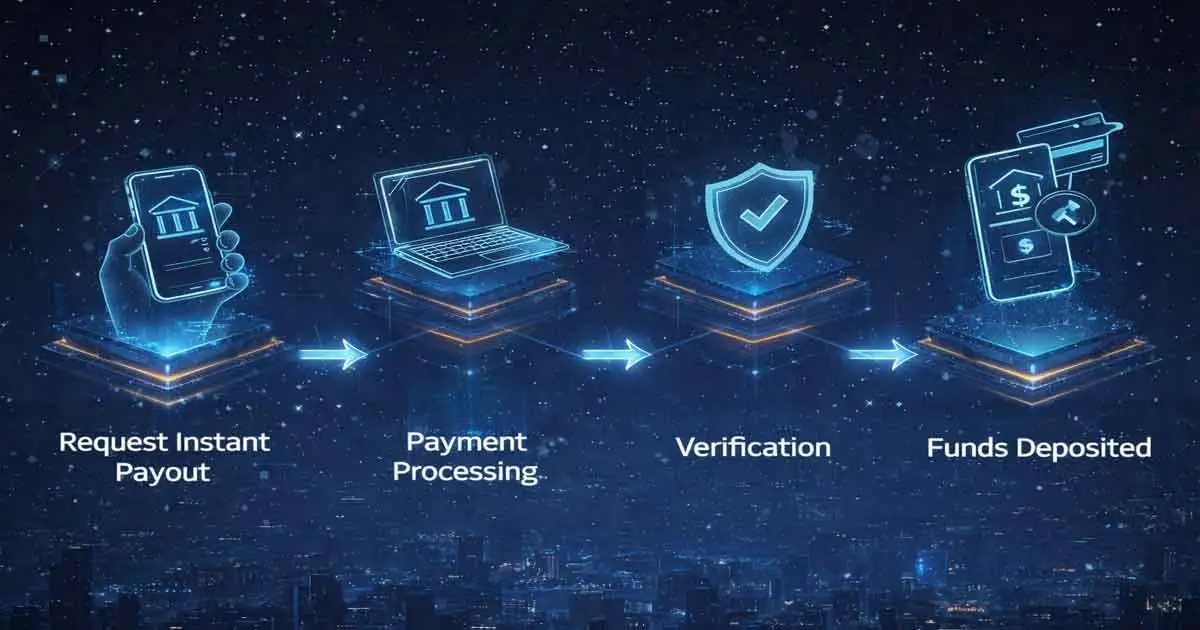
An instant payout workflow typically follows these steps:
- Payout trigger: A payout is triggered by a business via its internal system or dashboard.
- API call to payout gateway: The request is made to an Indian payout API provider with the details of the beneficiary and amount.
- Beneficiary Validation: Before the funds move, the system performs a mandatory “Penny Drop” or “Penny-less” check to confirm the recipient’s name and account status match bank records, preventing wrong-account transfers. The system conducts beneficiary validation, balance checks, and rule-based checks.
- Routing via payment rail: Routed via UPI/IMPS based on configuration.
- Real-time credit: Beneficiaries receive funds in real-time or near-real-time, depending on the specific payment rail used and the current availability of the destination bank’s servers.
- Confirmation and reconciliation: The status of transactions, reference IDs, and reports are exchanged in order to reconcile.
This method is an API-based framework that guarantees transparency, traceability, and speed.
Choosing the Right Payout API Provider in India
In considering an instant payout payment gateway, companies must consider:
- Regulatory requirements, such as RBI and NPCI standards;
- Support of numerous payment rails (UPI, IMPS);
- Documented API/uptime;
- Reconciliation and reporting feature, and the level of security and data protection.
In the Indian context, where bank-side downtimes are common, the best providers offer intelligent routing. This ensures that if one payment channel fails, the system automatically redirects the payout through an alternative path to maintain high success rates.
A good payout API must be designed to work with existing ERP, core banking or platform systems/internal system.
SabPaisa’s Role in the Instant Payout Ecosystem
SabPaisa, the RBI-authorised payment aggregator offering precision payout services. SabPaisa enables you to make disbursements in a confident way with automatic, instant and multi-mode payments.
Easily handle your payouts: make payments, check their status, and make a number of disbursements with a single click. Take advantage of wide banking availability throughout India and a robust administrative dashboard customised with various applications.
Stop viewing payouts as just an expense; see them as an opportunity to optimise your operations.
How SabPaisa Supports Compliant Instant Payouts:
- Effective cash flow management: Seamlessly make bulk payments, including UPI, and ensure that vendors, customers, and suppliers are paid in time, to facilitate day-to-day operations and expansion.
- Improved adherence and minimised risk: Prompt and controlled payments foster good relations and ensure you can meet regulatory criteria, reducing regulatory and operational risk and the risk of reputational loss.
- Improve operational performance: Remove manual payment procedures by automating your payout system; schedule payments, recurrent transactions and deal with bulk salary payments, and save time, energy and administrative expenses.
- Better financial planning: A sound payment system will make sure that all payments are timely to avoid late payments and dissatisfaction as well as free resources available to carry out accurate budgeting and financial forecasting.
Conclusion
As India’s digital economy matures in 2026, instant payout has become an essential capability for businesses focused on scale, compliance, and experience. Real-time payouts are measurable across industries due to faster settlements and higher trust of the partners.
The key to success is ensuring that the payout API provider is selected correctly which balance speed with regulatory rigour in its regulatory approach. Allowing safe, open, and API-based instant disbursements, services such as SabPaisa assist organisations to modernise their payment processes and remain in line with the anticipations of the RBI and NPCI.
Instant payouts are no longer an option, but a necessity to the business of Indian enterprises who intend to grow in the long term.
FAQs
1. What is the difference between instant payout and regular payouts?
Instant payouts credit funds instantly or within minutes and regular payouts are delayed and processed in batches with settlement delays.
2. Are instant payouts allowed under RBI regulations?
Yes. Instant payouts are permitted when routed through authorised payment rails such as UPI and IMPS via compliant payout service providers.
3. Which industries benefit the most from instant payout in India?
The high volumes of transactions are beneficial to marketplaces, NBFCs, insurers, fintech platforms, and large enterprises.
4. What is a payout API in India?
A payout API allows businesses to programmatically issue, monitor and reconcile payouts via a secure and controlled interface.
5. What is the average time it takes for instant payments to reflect?
The money often shows up immediately after an instant payment has been made, within 30 minutes, sometimes within a few seconds or a few minutes and the businesses can enjoy access to their money immediately.