
Aspiring entrepreneurs and business owners both depend on knowing the difference between SME and MSME in India in the ever-changing economic scene of today. Though they have different definitions, regulatory systems, and financial support systems, both are absolutely important in promoting innovation, employment, and economic development. We will discuss what exactly qualifies as an SME, investigate the main distinctions between MSMEs and SMEs, and talk about some MSME benefits in this blog. However, understanding what is the difference between MSME and SME isn’t just a theoretical concept — it has real implications for compliance, access to government schemes, taxation, funding eligibility, and overall business strategy. Both play critical roles in India’s economic landscape, but their legal definitions, investment limits, and support systems are different. Let’s simplify this difference to help entrepreneurs, startup founders, and small business owners make informed decisions.
What is SME?
Small and Medium Enterprises (SMEs) are companies run on a smaller scale than bigger companies. Different nations define what exactly qualifies as an SME. Under the MSMED Act of 2006, for instance, small and medium companies in India are classified depending on investment levels. On the other hand, in European nations, SMEs are mostly characterised by their workforce: companies with less than 50 people are categorised as small; those with less than 250 employees are categorised as medium.
Basically, although SMEs are a basic idea used worldwide, MSME is its particular Indian definition. This difference emphasises how different areas give different factors—such as investment against workforce size—different priorities when defining small and medium firms. Entrepreneurs trying to negotiate local rules and properly access support tools must first understand these categories.
What is MSME in India?
The MSMED Act of 2006, which established Micro Small and Medium Enterprises, was passed by the Indian government in 2006. Previously, MSMEs were grouped into the following categories, as established in the MSMED Act of 2006:
- A manufacturing company: The companies in this category manufacture goods in any industry, and their investment levels determine their classification.
- A business that provides services: These enterprises provide services to others (in terms of investment in equipment). Within this, Investment levels are the basis for categorising businesses.
The difference between SME and MSME has been abolished under the updated MSME classification as of July 1, 2020. Although both terms are often used interchangeably, what is the difference between MSME and SME lies mainly in the updated classification criteria, legal recognition, and access to specific government schemes. MSME is a more defined and structured Indian classification, whereas SME is a broader term used globally to refer to small and medium businesses. The turnover limit is included in the updated categorisation. In addition, the difference between SME and MSME is based on the money invested by enterprises in any fixed asset, as follows:
| Classification | Micro | Small | Medium |
| Manufacturing and Service sector | Investment should not exceed 1 crore, and the turnover should not exceed 5 crores. | The investment should not exceed 10 crores, and the turnover should not exceed 50 crores. | The investment should not exceed 50 crores, and the turnover should not exceed 250 crores. |
Objectives
A) Small and medium-sized enterprises (SMEs) are present in every country with the goal of:-
- Creating new job opportunities.
- Encouragement of entrepreneurial endeavours.
- Improving the living conditions of the impoverished.
- Increasing the SME sector’s contribution to the country’s GDP.
B) The Ministry of Micro, Small, and Medium Enterprises has set the following goals for the MSME sector:-
- Encourage entrepreneurship in small and medium-sized businesses.
- Increase the MSME sector’s contribution to India’s exports.
- Administrative processes are improving.
- Providing work possibilities for the most vulnerable members of society.

SMEs Across the World
In other nations, SMEs have a significant presence:
- Africa: Small and medium-sized enterprises (SMEs) account for half of the continent’s GDP, with SMEs accounting for about 90% of all businesses.
- Japan: Value-added, it contributes more than half of the GDP. SME employment accounts for 70% of overall employment in the country.
- Pakistan: In 2018, SMEs accounted for 30% of Pakistan’s GDP. Exports accounted for 25% of total employment, while national employment accounted for 78%.
- China: Small and medium-sized enterprises (SMEs) account for over 90% of all firms in the country. Their GDP contribution is 60%, and they are responsible for 80% of all national employment.
- United States of America: In the United States, about 27 million SMEs account for 66.6% of all jobs. Their contribution to the country’s GDP is somewhere around 50%.
- Europe: Small and medium-sized businesses (SMEs) account for 70% of job creation in European countries.
- Australia: SMEs account for almost 98% of all firms in Australia, and they provide 33.5% of the country’s GDP.
MSMEs in India
MSME sector in India has a significant share:
Comprising 45% of manufacturing output and 40% of total exports, MSMEs form the backbone of the Indian economy and greatly help to generate employment in the nation. From 3.87 lakhs in 2017 to 5.875 lakhs in 2018, the count of jobs generated by micro-enterprises jumped by 51.6% in one year. Moreover, the Director of the Ministry of MSMEs claims that this industry produces thirty percent of the national GDP.
With 63.4 million small and medium businesses (SMEs) employing around 460 million people and making almost 30% of India’s GDP, the CII estimates that the industry employs about 120 million Indians and generates 33.4% of India’s industrial output. Including this into exports, SMEs provide about 45% of all exports.
Although SMEs make a sizable share of India’s GDP, a poor rate of technology adoption and traditional, ineffective corporate processes have kept smaller companies from reaching their full potential.
Google’s study indicates that out of the 51 million SMEs, 68% lack internet connection. India’s SMEs are still in their early years and will enter the next stage of corporate development, but not fully realised. The finance ministry set a target of $5 trillion for India’s GDP, and SMEs are vital to reach that target; yet, adoption of technology is the sole obstacle; thus, these digital companies are filling in to provide solutions for SMEs to flourish.
What is the Difference Between MSME and SME in India?
To effectively navigate the business landscape, it’s essential to understand the critical distinctions between Small and Medium Enterprises (SMEs) and Micro, Small, and Medium Enterprises (MSMEs), as these differences can significantly impact funding opportunities, regulatory requirements, and overall business strategies. While SMEs are a globally used term, MSMEs are specifically defined under Indian law with a clear framework for investment, turnover, and employee size. To understand what is the difference between MSME and SME, here’s a quick breakdown:
| Aspect | MSME | SME |
| Definition | Micro, Small, and Medium Enterprises | Small and Medium Enterprises |
| Categories | Includes micro (up to 10 employees), small (11-50), and medium (51-250) | Small (up to 50 employees) and medium (51-250) |
| Revenue Threshold | Varies by country; typically lower for micro and small | Generally higher than MSME thresholds |
| Focus | Promotes grassroots entrepreneurship and job creation | Focus on contributing to overall economic development |
| Support Systems | Often has specific government schemes and funding aimed at supporting micro and small businesses | Receives broader support but less targeted than MSME |
| Regulatory Framework | May have simplified regulations for smaller entities | Generally follows standard business regulations |
| Market Reach | Often local or niche markets | Can operate on regional, national, or international scales |
| Innovation | Encouraged through local initiatives | Focus on scaling existing innovations |
Key Financial Institutions Supporting SME Growth
Established by the International Finance Corporation, the Global SMEs Finance Facility helps SMEs in developing nations meet their financial needs by means of funding, risk reduction, and consulting services, thereby supporting SMEs.
Creditable commercial banks, NBFCs, RRBs, SIDBIs, NSIC, NEDFi, and SFBs across India qualify to provide loans to MSMEs. New as well as established SMEs can borrow. Among the loans MSMEs can apply for are MUDRA loans, CGTMSE loans, and PMEGP loans; the loan amount under each program ranges from a minimum of INR 50 crores to a maximum of INR 200 lakhs or 2 crores.
MSME Business Ideas
The MSME sector offers a plethora of business opportunities that cater to diverse interests and market needs. Here are some promising MSME business ideas:
- E-commerce Store: With the rise of online shopping, starting a niche e-commerce store can tap into specific consumer needs and preferences.
- Food Truck: Offering unique culinary experiences through a food truck can attract food enthusiasts while keeping initial costs manageable.
- Digital Marketing Agency: As businesses increasingly turn to online platforms, a digital marketing agency can provide essential services like SEO, social media management, and content creation.
- Handmade Crafts: If you have a knack for arts and crafts, selling handmade products on platforms like Etsy can be a fulfilling and profitable venture.
- Health and Wellness Coaching: With a growing focus on health, becoming a wellness coach can appeal to individuals looking to improve their lifestyles.
- Mobile App Development: As mobile usage continues to rise, creating apps tailored to specific user needs presents a lucrative opportunity for tech-savvy entrepreneurs.
MSME Schemes in India
The Indian government has played a pivotal role in promoting the growth and development of MSMEs through comprehensive policies and targeted schemes. The MSME policy in India aims to empower small businesses, improve their competitiveness, and boost their contribution to GDP and employment.
Key Highlights of the MSME Policy in India:
-
Ease of Doing Business: Simplified registration through the Udyam portal with Aadhaar and PAN integration.
-
Priority Lending: Under priority sector lending, banks are required to allocate a specific portion of their credit to MSMEs.
-
Infrastructure Development: The establishment of MSME clusters, parks, and technology centres for sector-specific growth.
-
Digital Enablement: Incentives for digital transformation and participation in e-commerce platforms.
Popular MSME Schemes in India:
-
Prime Minister’s Employment Generation Programme (PMEGP)
The Prime Minister’s Employment Generation Programme (PMEGP) is a flagship initiative that provides financial assistance for establishing new self-employment ventures. -
Credit Guarantee Fund Trust for Micro and Small Enterprises (CGTMSE)
This initiative enables MSMEs to secure loans from banks and financial institutions without the need for collateral. -
MUDRA Loan Scheme
Offers microfinance under three categories: Shishu, Kishor, and Tarun — based on the business stage and loan amount. -
MSME Champions Scheme
The MSME Champions Scheme is a technology-enabled platform that facilitates grievance redressal and empowers MSMEs to become national and global champions. -
Technology and Quality Upgradation Support to MSMEs (TEQUP)
The program assists enterprises in adopting energy-efficient and quality-enhancing technologies.
These MSME schemes in India provide funding and ensure that small businesses receive the necessary training, infrastructure, and market access to scale sustainably.
Importance of Digital Payments for SME & MSME Growth
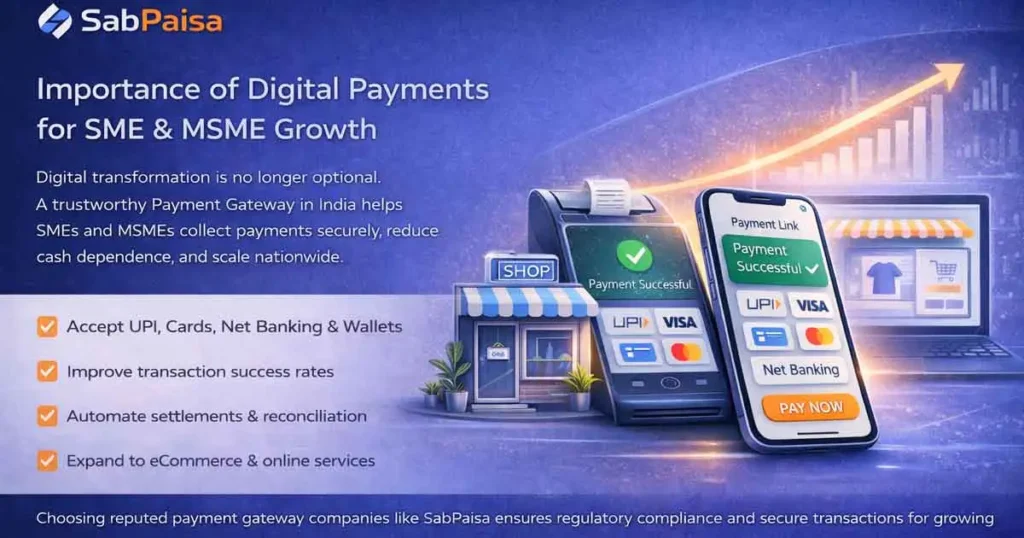
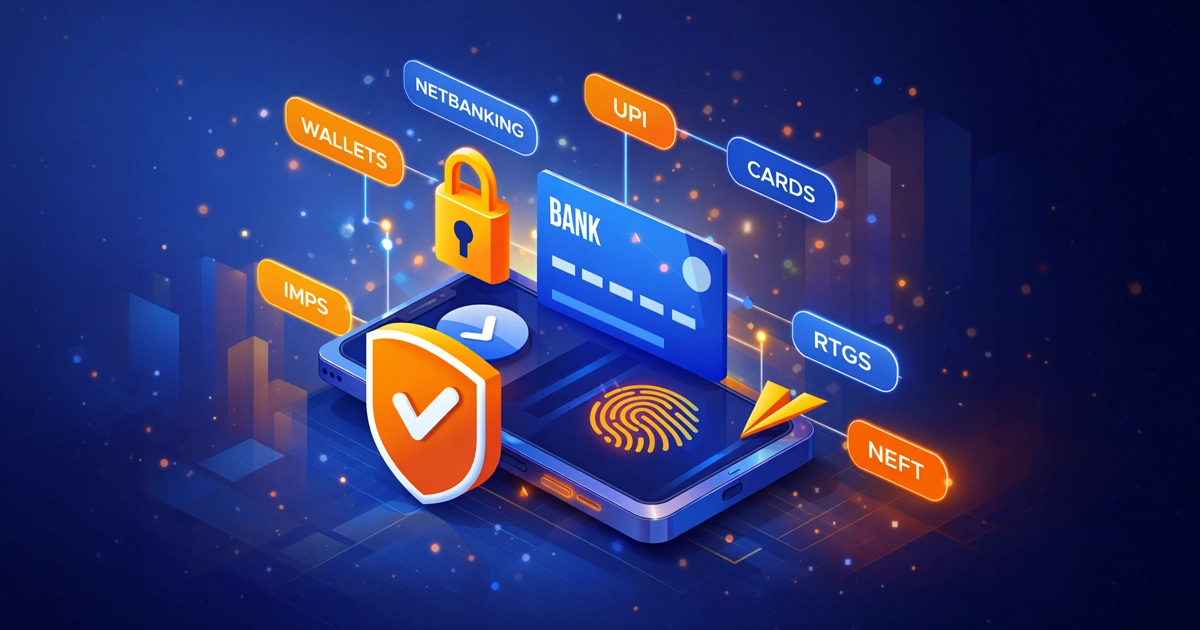
Digital transformation is no longer a choice in the case of SMEs and MSMEs. A trustworthy Payment Gateway In India enables companies to obtain payments safely, minimize cash dependence, and expand nationwide. With the best Online Payment Gateways In India, businesses are able to:
- Accept UPI, cards, net banking and wallets.
- Enhance the success rate of transactions.
- Automate settlements and reconciliation.
- Diversify to eCommerce and online services.
Choosing from reputed Payment Gateway Companies in India, like SabPaisa, ensures regulatory compliance and secure transactions, especially important for growing MSMEs.
Why MSMEs Should Choose a Payment Aggregator
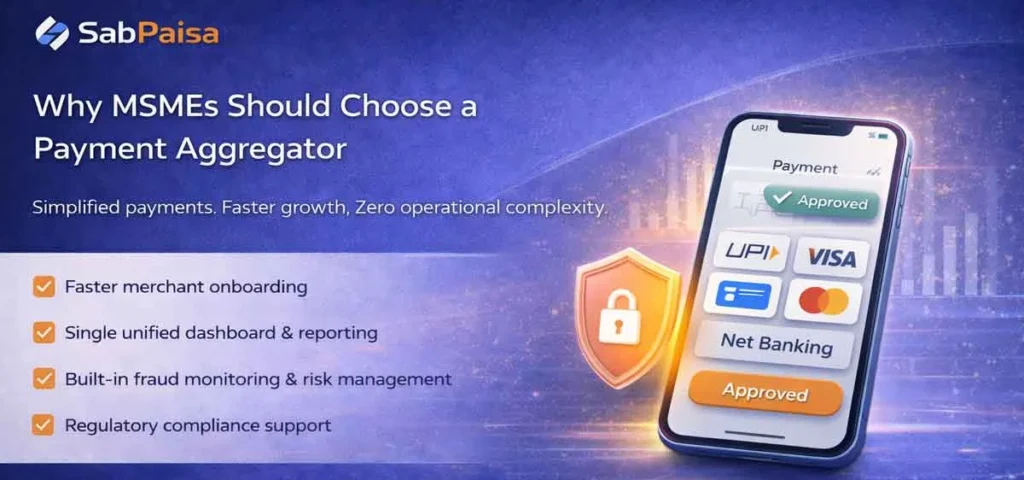
A Payment Aggregator streamlines the onboarding experience of MSMEs by enabling them to offer a variety of payment methods on a single platform without having to separately integrate with banks. The businesses would enjoy:
- Faster merchant onboarding
- Single dashboard/reporting.
- Fraud monitoring, risk management.
- Support of regulatory compliance.
Collaborating with one of the Leading Payment Aggregators In India, like SabPaisa, means that MSMEs will not need to worry about operational complexity but rather on growing.
One-Stop Payment Solutions for SMEs & MSMEs
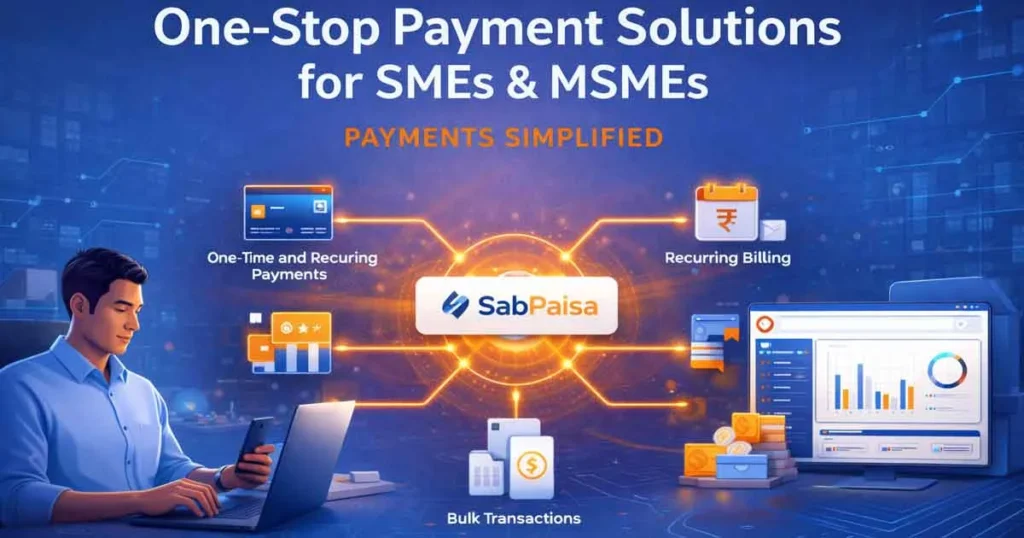
Expanding companies need One Stop Payment Solutions, integrating collections, recurrent billing, and payouts within a single ecosystem. Modern Payment Solutions assist SMEs/ MSMEs:
- Receive one-time and recurring payments.
- Allow offline and online collections.
- Automate vendor payouts.
- Easy to transact bulk transactions.
One-stop payment services, such as SabPaisa, will reduce reliance on multiple vendors and facilitate smoother financial management.
How SMEs Can Choose the Best Payment Gateway
In determining Which Is The Best Payment Gateway In India, SMEs need to take into consideration:
- Transaction success rate
- Integration flexibility
- Settlement timelines
- Security certifications
- Customer support
An India Top Payment Gateway provider must be compliant and scalable. Businesses are also advised to determine whether the Best Payment Gateway Website offers clear pricing and straightforward onboarding.
Collaboration with a trusted Payment Gateway Company in India, such as SabPaisa, will guarantee scalability over the long term and secure payment receipt.
Payment Gateway Integration Options for SME/MSME Platforms
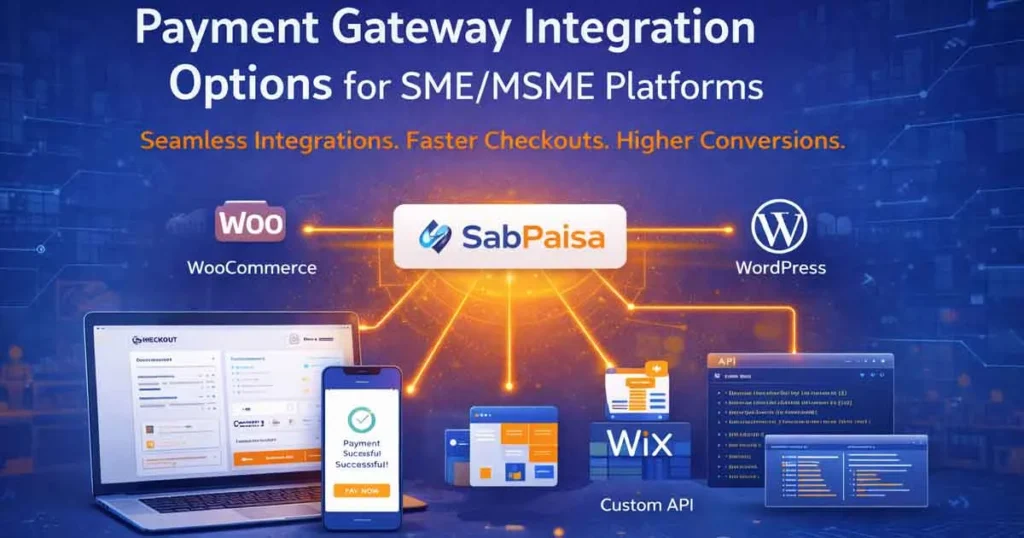
Ecommerce payment gateway must be integrated well with the online ecommerce platform. Popular integrations are:
- WooCommerce e-commerce payment gateway.
- WordPress business web payment gateway.
- Wix’s small online stores payment gateway.
- Enterprise-level custom API integrations.
Choosing the reliable Payment Gateway Provider India will guarantee smooth checkout experiences and increased conversions.
Instant Payouts & Payout APIs for SME/MSME Cash Flow
Cash flow management is vital to MSMEs. Services such as instant payouts enable enterprises to receive funds instantly. Using a powerful payout api, businesses are able to:
- Automate supplier and vendor payments
- Process refunds instantly
- Time schedule bulk payments
- Maintain real-time tracking
SabPaisa enables rapid settlements and payout automation, helping MSMEs retain operational liquidity.
Payment Links for Offline & Semi-Digital MSMEs
Not every MSME is entirely online. Businesses can collect payments without a site using a generator of payment links. MSMEs can process a payment through:
- Share through WhatsApp, SMS, or email.
- Take up payments through UPI and cards instantly.
- Real-time payment status tracking.
- Reduce manual follow-ups
Knowing how to create payment link options assists semi-digital businesses to move seamlessly into complete digital use.
Final Thoughts
Now that you clearly understand what is the difference between MSME and SME, it becomes easier to identify where your business fits, which policies apply to you, and which government schemes you can take advantage of. While both support entrepreneurship and job creation, MSMEs in India enjoy a structured benefit system — including easier funding access, tax exemptions, priority lending, and digital transformation grants.
Whether you’re a growing small business or an emerging medium enterprise, choosing the right classification is the first step toward sustainable growth, compliance, and better financial support.
FAQs
1. What does SME mean?
SME refers to businesses that operate on a smaller scale compared to large corporations, typically defined by criteria such as the number of employees and annual revenue.
2. What is the full form of SME?
The full form of SME is Small and Medium Enterprises. This term encompasses a wide range of businesses that are crucial for economic growth and job creation.
3. How are SMEs classified?
SMEs are classified based on various criteria, which can differ by country. Generally, they are categorised into small businesses (often with fewer than 50 employees) and medium-sized companies (typically with fewer than 250 employees).
4. What is the significance of SMEs in the economy?
SMEs play a vital role in the economy by contributing to employment, fostering innovation, and driving local development. They often serve niche markets and can adapt quickly to changing consumer needs.
5. What support is available for SMEs?
Many governments and organisations offer support for SMEs, including funding, grants, mentorship programmes, and training resources. This assistance is designed to help them grow and thrive in competitive markets.
6. What does MSME stand for?
MSME stands for Micro, Small, and Medium Enterprises. It refers to businesses categorised by their size, with micro-enterprises being the smallest, followed by small and medium enterprises. The classification varies by country, often based on factors such as investment and the number of employees.
7. What are the benefits of MSME registration?
Registering as an MSME can provide several advantages, including access to government schemes and subsidies, more accessible access to loans and funding, tax benefits, and enhanced credibility with customers and suppliers. This registration can significantly aid in the growth and sustainability of small businesses.
8. What is the difference between MSME and SME?
SMEs refer to small and medium enterprises in general business terms, whereas MSMEs are formally recognised under Indian law with investment and turnover-based classifications. MSMEs receive government-backed benefits such as subsidies, priority sector loans, grants, and tax advantages; SMEs may or may not fall under such schemes depending on their jurisdiction.