


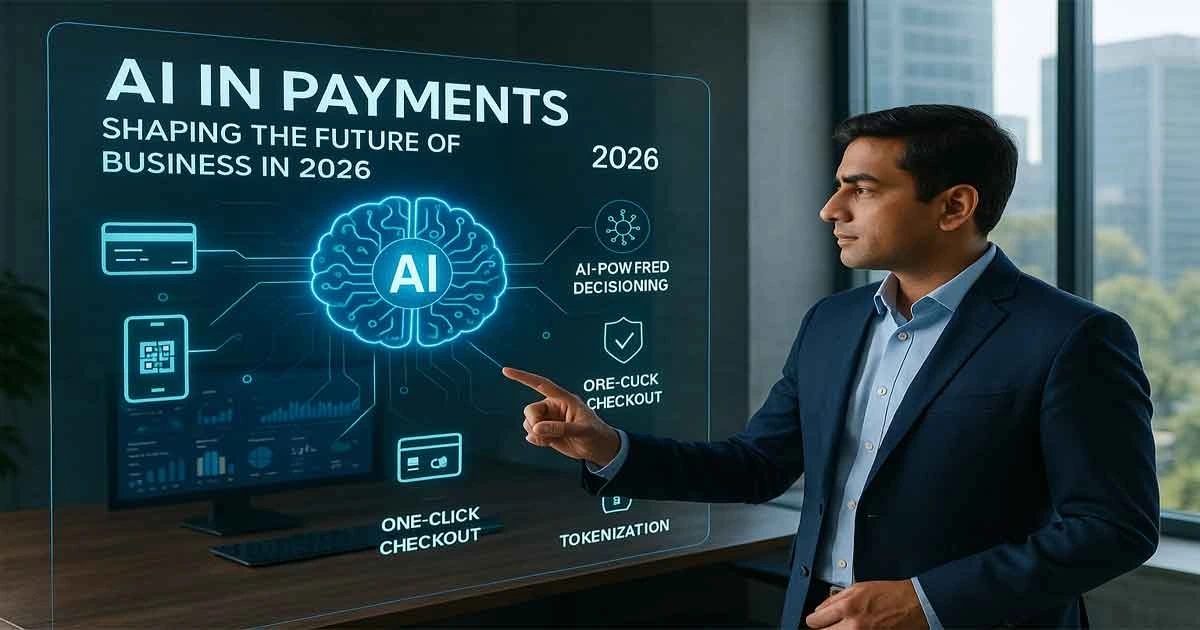
Money travels fast. It travels internationally, between accounts, through digital wallets, and into the pockets of millions of people – instantly and with a speed that never slows down. Behind every click, swipe or tap, the use of AI in payment makes thousands of decisions in microseconds. Not just to authorise or decline a transaction, but to detect the subtlest signs of fraud, optimise the path of payment and predict customer behaviour before it happens.
Implementing AI in payments is the best way to meet the increasing demand of the clients and the changing needs of the business. The benefits of automation, early detection of fraudulent activity, smoother payment processing, and personalised customer service all make investments into artificial intelligence appealing for generating higher profits, saving operating costs, and improving transactional relationships across the board, encompassing Business-to-Consumer (B2C), Business-to-Business (B2B), and Public-Sector (G2C/G2B) transactions.
This blog outlines how AI is impacting digital payments, the trends emerging within this industry, and why SabPaisa is uniquely positioned in this evolving landscape.
What Is AI in Payments?
AI in digital payments refers to the incorporation of intelligent computer systems, such as machine learning, language understanding, and data analysis, into the way we handle financial transactions. It utilises AI to enhance financial processes, including payment processing, security, fraud detection, and customer interactions.
AI in digital payments analyses vast amounts of information, enabling payment systems to become smarter, work faster, and operate more efficiently. These systems adapt to how people use them and what’s happening in the market, all while strictly adhering to regulatory mandates for India, including compliance with PCI-DSS for card data security, the Reserve Bank of India (RBI) guidelines, especially for data localisation and two-factor authentication (2FA) and the security layer provided by mandatory tokenisation.
How AI is Changing the Digital Payment Industry
AI-driven solutions enable businesses to offer secure, efficient, and frictionless payment options while addressing challenges and unlocking new growth opportunities. It also includes digital payments with AI, allowing service providers to prevent fraud, enhance the customer experience, automate processes, and reduce operational costs. Let’s explore more into this:
- Fraud monitoring: With proper integration of AI, one can analyse the amount of data and identify patterns, anomalies, and behaviour to detect fraudulent activities in the system. When examining instant gratification scenarios, such as ticketing, recharges, coupons, and on-demand services, where a product or service is consumed instantly, AI can enable fraud monitoring tools to simulate dynamic workflows that it can conceive through its inherent self-learning capabilities. These can go a long way to reducing any manual intervention for risk referrals of borderline cases by making the system self-reliant.
- Speed and efficiency: With AI, you can streamline and automate complex processes and thus speed up many tasks. For example, client onboarding and enablement can be completely automated. It can lead to quicker activations and revenue realisation. Another key impact area is transaction monitoring, sending proactive alerts, and decision-making systems that can drive high system performance and customer success.
- Customer Experience: Customer experience is a relatable topic for everyone when discussing AI. It improves customer experience with personalised services by tracking behaviour, preferences, and feedback. For example, analysing the patterns and highlighting the preferred payment modes or options for the customer as the first option at check-out or suggesting the best possible modes or options for a unique combination of cart items to help the customer get the best available offer.
- Innovation: AI can revolutionise the collation of qualitative and quantitative data and analyse it to evaluate the product-market fit hypothesis. It will help companies understand who the right customer is and what their real needs are. AI can also drive the efficiency and speed of product teams in creating mock-ups and prototypes, which can be a boon as teams can quickly build and rebuild with unprecedented accuracy. It will eventually lead to quicker rollouts, and can help convert customer feedback into data for analysing the actual v/s potential impact of the product or feature. It will create a valuable feedback mechanism, driving the innovative product development lifecycle.
Key Trends in AI Payments for 2026
Here are the significant developments driving AI in the payments industry toward 2026:
- Real-time credit risk and fraud detection: AI models monitor transactions as they happen, flagging anomalies and reducing losses. This is a crucial consideration for the development of robust AI payment systems.
- Smart routing and payment optimisation: AI determines which payment channel, bank, or network will be successful in advance, increasing the success rate of AI payments.
- Personalised user experiences: Leveraging AI in payments enables customised checkout flows, dynamic risk scoring, and seamless experiences tailored to Indian consumers.
- Offline-online integration: With platforms like SabPaisa bringing together physical counters and online payments, artificial intelligence in digital payments will manage the unified flow.
- Voice, chat-based payments, and conversational AI: As India’s non-smartphone users and vernacular languages are increasingly adopted, AI in payments industry will drive voice-activated or chat-based payment flows.
- Embedded finance and AI commerce: Payments become embedded into apps, marketplaces, and services. AI handles checkout and friction, supporting broader AI payment systems.
Challenges of AI in payments
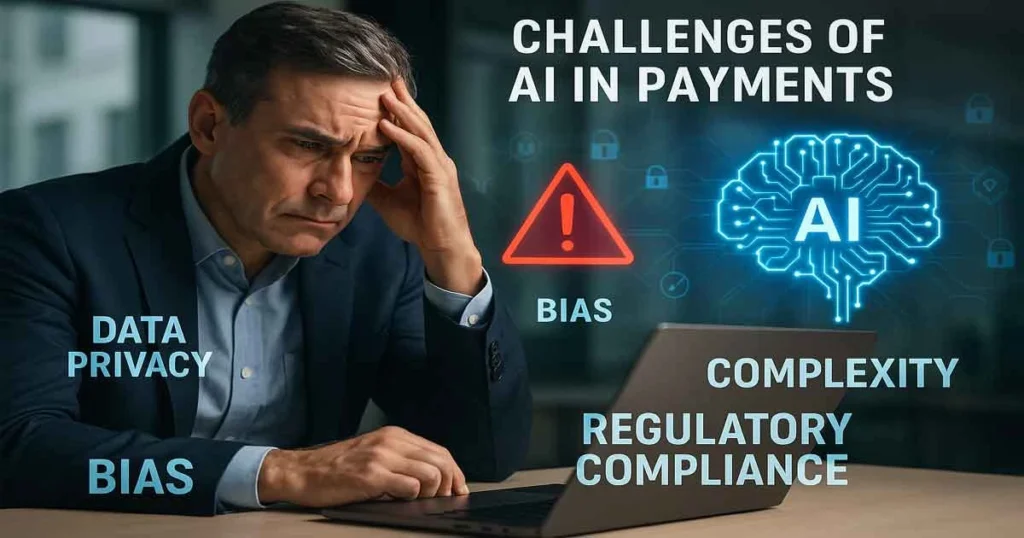
Despite its immense capabilities, AI still faces a few significant challenges:
- Data Privacy and Data Security: The use of AI depends on data, which brings up privacy and security concerns. Bank and financial institutions should consider both the innovation and consumer trust by adhering to the regulations in the region and globally.
- Legacy Infrastructure: The core systems used by many banks are decades old. To implement AI, modernisation, including the implementation of cloud-native architectures or middleware solutions like digital twin technology, which can simulate real-time operations without a complete system overhaul, will be necessary.
- Regulatory Uncertainty: AI regulation in financial services is in process of change. Institutions need to balance between the changing compliance demands and establish fairness and transparency in AI-based decision-making.
- Operational Expertise: AI implementation demands expert personnel to develop, test and improve models. To bridge knowledge gaps, financial institutions need to invest in training their employees and have technology partners.
Fortunately, humans excel at these things, whereas AI excels at tasks that slow us down. That is why humans and technology collaborate so much more efficiently than we could individually.
Why SabPaisa Is Well-Placed for AI in Payments
For organisations exploring AI in payments, SabPaisa offers a robust operational foundation that aligns with India’s digital-first environment.
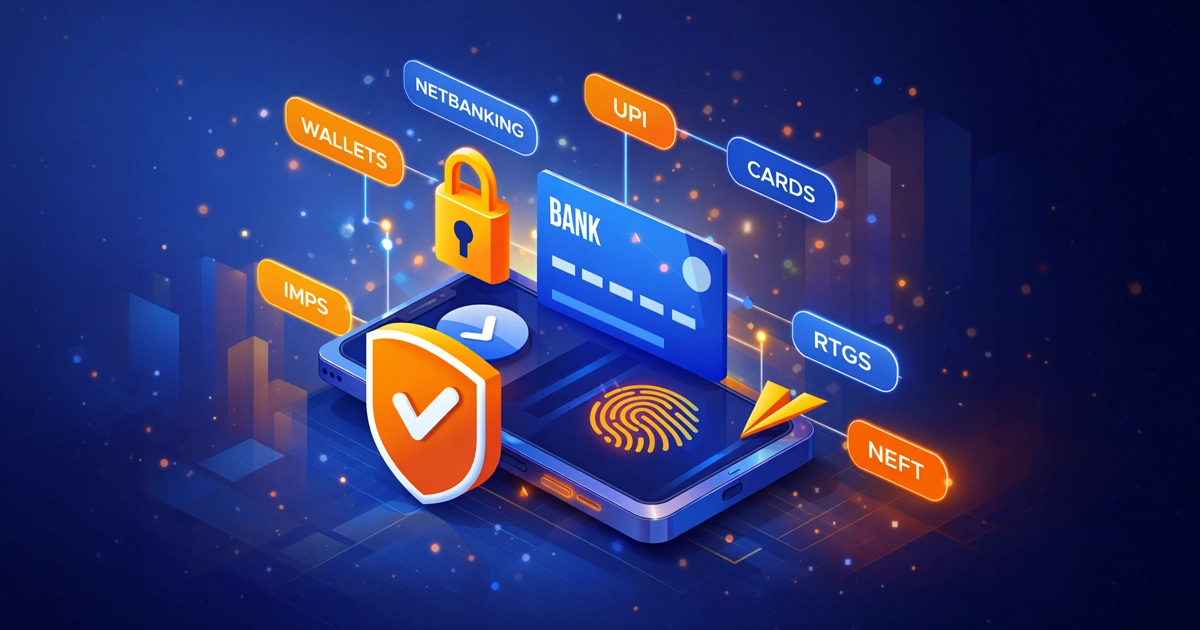
SabPaisa is an RBI-authorised payment aggregator and the world’s first unified payment platform, operating within a single ecosystem that combines online and offline collections. Its model supports a wide range of payment modes, including cards, net banking, UPI, IMPS, wallets, e-cash, e-NEFT, and Bharat QR, making it naturally compatible with AI-enabled payment flows, which require unified and structured data.
A few reasons why SabPaisa is strategically positioned for AI adoption:
- Its hybrid online-offline infrastructure is built for large-scale transaction environments, which is essential when deploying AI models.
- Its advanced APIs can integrate with AI-based routing engines and fraud detection tools.
- Its scalable architecture enables businesses to effectively run AI-led risk scoring, optimisation models, and monitoring systems.
Whether serving enterprises, startups, or public sector institutions, SabPaisa‘s platform offers the stability, compliance, and interoperability needed for India’s evolving AI-driven payments landscape.
In Summary
There’s no question that AI is changing the face of financial operations, but the day when machines can replace human finance teams won’t be anytime soon, if ever. Instead, AI is partnering with human beings to help improve accuracy in their transaction data, prevent fraud, and ensure the application of best practices throughout the payment process.
AI may be developing at a dizzying speed, but the need for strong finance teams is greater than ever. Service providers that depend on AI to augment their core strengths and help them make confident decisions in real-time.
Frequently Asked Questions (FAQs)
1. How does AI enhance customer experience in payments?
AI personalizes payment interactions, offering contextual payment links and reducing friction leading to higher conversion and satisfaction.
2. How will the future of AI in payments impact transaction speed and scalability?
The future of AI in payments promises to revolutionise transaction speed and scalability by leveraging advanced algorithms and real-time data processing. Thanks to predictive analytics and automated optimisation, AI will enable payment systems to handle exponentially higher transaction volumes with minimal latency.
3. Why should small businesses adopt artificial intelligence in digital payments?
AI helps small businesses reduce the workload involved in running their operations, enhance fraud protection, and even provide faster and more personalised checkout experiences, enabling them to compete with larger players.
4. Is AI reliable for fraud detection in high-velocity transaction sectors?
Yes, AI models can be used to analyse behaviour patterns and detect anomalies in large datasets, enabling real-time detection, which makes them ideal for sectors such as ticketing, e-commerce, recharge, and on-demand services.