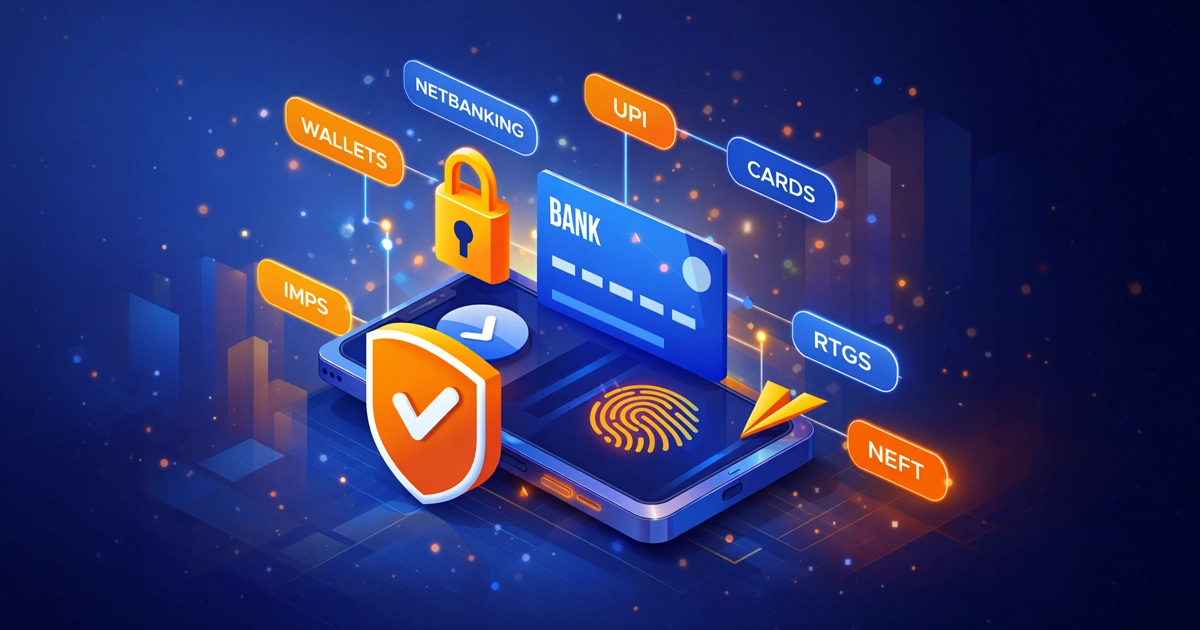





Indian merchants are scaling rapidly—D2C stores, marketplaces, mobile apps, and branch counters often operate simultaneously. Despite this growth, payment challenges—from UPI failures to delayed refunds—continue to slow conversions, disrupt cash flow, and affect customer trust. Choosing the right payment gateway in India, streamlining processes, and adhering to compliance standards can be the difference between smooth revenue and persistent losses. This article explores the most common hurdles across India’s payment rails (UPI, cards, net banking, NACH/eNACH), their significance, and how modern, compliant payment stacks effectively address them.
Understanding Merchant Payment Challenges in India
“Payment challenges” are recurring friction points that derail successful collections, reconciliation, or customer experience. Typical examples include UPI intent timeouts, misconfigured QR flows, card tokenisation changes, settlement ambiguity, chargebacks, and compliance in payments under RBI/NPCI mandates (e.g., tokenisation, data localisation, and Online Dispute Resolution). RBI has formalised Online Dispute Resolution (ODR) for digital payments and a standard turn-around time (TAT) for failed transactions and compensation, making disciplined resolution a must-have, not a nice-to-have.
Why Addressing These Challenges is Critical
Addressing payment challenges early is critical for merchants looking to scale efficiently. Smooth, reliable payment processes not only prevent operational bottlenecks but also build customer confidence and protect revenue. By proactively tackling these issues, merchants can unlock measurable improvements across their business.
Key benefits include:
- Higher conversions: Smooth, reliable payments prevent lost sales.
- Fewer support tickets: Automating dispute resolution and refunds reduces manual effort.
- Faster settlements & reconciliation: Streamlined processes save time and reduce errors.
- Stronger brand trust: Customers return to merchants they trust to handle payments efficiently.
- Protected margins at scale: Transparent costs and fewer failures prevent revenue leakage.
The Top 5 Payment Challenges Merchants Face

1) High Processing Fees and Hidden Costs
The issue: Pricing can be opaque across various instruments, including UPI, cards (domestic/international), and net banking. The effective cost per successful transaction rises when failures or downtime are high.
What to do:
- Track cost per successful payment by instrument and bank.
- Use smart routing and idempotent retries to ride over issuer/acquirer downtime.
- Model net economics when shifting from COD to prepaid (offers, MDR equivalents, and failure rates).
- Consolidate settlements to cut reconciliation time.
2) UPI Integration Issues for Merchants & Fragmented Options
The issue: UPI is ubiquitous. However, its many modes—collect, intent, static or dynamic QR, AutoPay mandates, and Single Block Multiple Debits (SBMD)—are often poorly orchestrated, leading to timeouts, duplicate pulls, and QR confusion. NPCI requires brand-compliant QR displays and standardised UPI ID presentation. Non-compliance can result in penalties and customer frustration.
What to do:
- Prefer intent + dynamic QR for speed and better success; keep collecting as a fallback.
- Validate QR/UPI ID formatting and placement as per NPCI brand rules; maintain a dispute route.
- Use AutoPay for subscriptions/EMIs and SBMD for deposits/pre-authorisations—both are NPCI-supported.
3) Fraud Risks and Compliance in Payments
The issue: Phishing, social engineering, merchant fraud, and misuse of collect requests increase disputes and chargebacks. India’s compliance stack is strict:
- Card tokenisation—merchants can’t store PAN or other card details; instead, they use network/issuer tokens.
- Data localisation—payment system data must be stored only in India, with supervisory access for RBI.
- ODR/TAT—merchants and participants must support online dispute resolution and adhere to RBI-prescribed TAT.
What to do:
- Enforce AFA/3-D Secure and tokenised cards by default; never store sensitive card data.
- Keep payment data resident in India; maintain audit-ready logs and evidence.
- Integrate an ODR path for failed transactions with automatic status tracking and escalation.
4) Refund Delays for Merchants
The issue: Refunds can be delayed due to acquirer-issuer hops, bank downtime, or partial capture logic. Slow refunds increase support tickets and cause customers to abandon carts in the future. The RBI has set standard TAT and compensation norms for failed transactions, and NPCI regularly updates UPI dispute and refund rules.
What to do:
- Use webhooks to trigger instant customer notifications when refunds are initiated/posted.
- Reconcile T+N statuses daily; auto-escalate past TAT via the ODR route.
- Display realistic, channel-specific refund SLAs at checkout and in email/SMS.
5) Cross-Border Payment Challenges & RBI’s PA-CB Regime
The issue: Exporters of services/SaaS and D2C brands face FEMA paperwork, purpose codes, disputes, and settlement windows. The RBI now regulates Payment Aggregators – Cross Border (PA-CB), setting authorisation, net-worth, and workflow norms (transitioning from older OPGSP models).
What to do:
- Use corridors and partners aligned to the PA-CB framework; ensure purpose-code tagging and bank reporting.
- Automate SOFTEX/FIRA documentation where relevant.
- Price for FX spreads/scheme fees and maintain a clear dispute playbook.
Industry Use Cases: How Sectors Are Impacted
| Sector | Key Payment Practices & Benefits |
| E-commerce / D2C | Dynamic UPI QR, tokenised cards, and one-click refunds reduce drop-offs and cart abandonment. |
| NBFCs / Fintech Lenders | UPI AutoPay for EMI collections, strict data localisation, and ODR ensure customer trust. |
| Co-operative Banks | Branch QR acceptance with NPCI-compliant display standards; simple dispute logging via ODR. |
| SaaS / IT Exporters | PA-CB aligned setups, purpose-code tagging, and automated reconciliation for recurring invoices. |
| Education / Healthcare | AutoPay / NACH mandates for fees or subscriptions with clear, channel-wise refund SLAs. |
How Modern Payment Gateways Help Merchants Overcome These Issues
A capable stack should:
- Orchestrate UPI (intent/collect/dynamic QR, AutoPay, SBMD), tokenised cards, netbanking, and payouts behind one API.
- Provide bank-downtime routing, idempotent retries, and granular error mapping to lift success.
- Offer ODR-ready dispute flows and refund automation aligned to RBI/NPCI timelines.
- Enforce data localisation and PCI DSS-class controls with full audit trails.
Conclusion: Turn Payments into a Growth Lever
The payment challenges merchants face in India are real—but fixable. Prioritise UPI reliability, tokenised cards, transparent pricing, fast and trackable refunds, and strong compliance in payments. Select a payment gateway India stack that unifies rails, automates ODR and refunds, and localises data by design. The payoff is higher success rates, cleaner reconciliation, and customers who trust you enough to return.
FAQs
1) What causes most UPI failures at checkout?
PSP/bank downtime, misconfigured UPI IDs/QRs, and slow intent hand-offs. Follow NPCI’s QR/UPI-ID display rules and offer alternate modes (intent + dynamic QR with collect as fallback).
2) Are merchants allowed to store card numbers?
No. Under RBI’s tokenisation framework, merchants and gateways must not store PAN or other card credentials; use tokens issued by the network/issuer.
3) How soon should failed payments or refunds be resolved?
The RBI has standardised the TAT and compensation for failed digital transactions, integrating ODR and automatically monitoring SLA breaches.
4) What is SBMD, and how is it useful?
Single Block Multiple Debits (SBMD) allows you to block funds and execute multiple debits against that block—useful for deposits, just-in-time fulfillment, and staged deliveries. NPCI enabled SBMD under UPI mandates.
5) What’s changing for cross-border collections?
The RBI’s PA-CB regime now governs cross-border aggregators; non-banks are required to obtain authorisation and must adhere to specific capital, reporting, and KYC norms.